

Inside The Chip Stack Winning The Humanoid Robot Boom
Mornings With Markman - May 19th, 2026

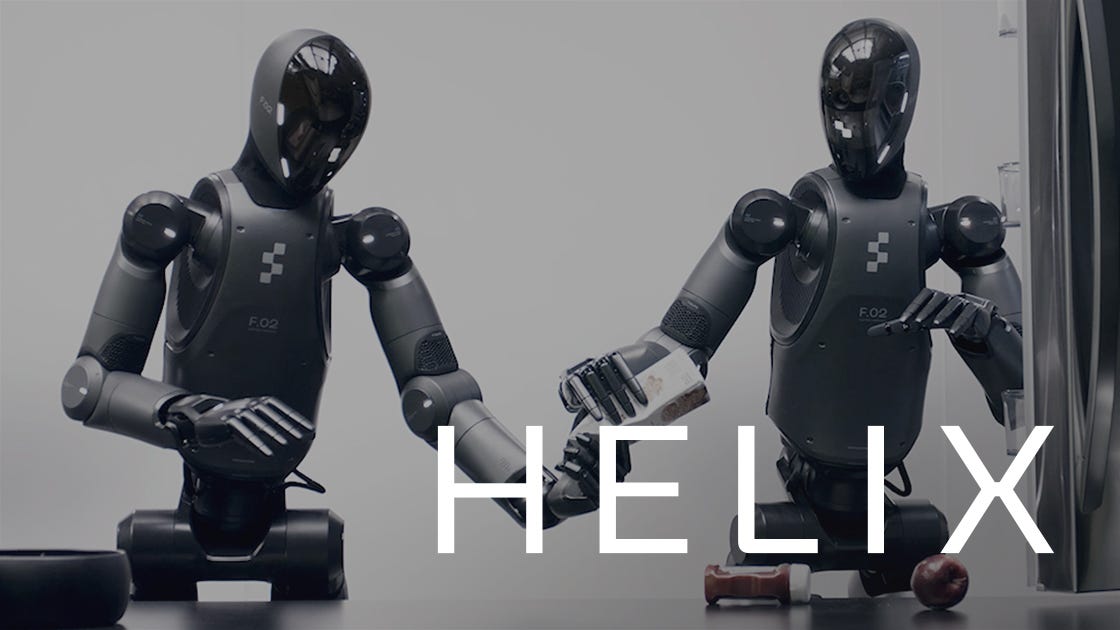
On May 13, four humanoid robots named Bob, Frank, Gary, and Rose climbed onto a conveyor belt at a Figure AI testing facility and began sorting packages. By the 24-hour mark, the four had moved more than 30,000 barcoded boxes between bins, recharging in shifts, with zero mechanical or software failures. The livestream ran past hour 38 with 47,000 packages handled before Figure called the demo.
CEO Brett Adcock framed it as proof that humanoids can hold a human shift. Most coverage took the headline at face value and pivoted to questions about labor displacement.
The detail buried inside Figure’s own technical description is the part that matters for investors. Helix-02, the neural network running the robots, was executing entirely on the hardware. No cloud connection. No data center round-trip. Every visual frame, every joint movement, every grip adjustment was inferred locally, on chips bolted to the robot’s torso.
That single architectural choice is where the investment story actually lives.
Helix-02: A Single Model For Everything
Helix-02 is a unified neural network that controls walking, manipulation, and balance from raw sensor data, replacing more than 109,000 lines of hand-coded locomotion logic with a single set of weights. Motor control runs at 200 Hz. Scene understanding runs at 7-9 Hz. Both loops are continuous; both must stay inside latency budgets measured in milliseconds.
Figure has confirmed the inference runs on dual Nvidia RTX GPU modules bolted inside the robot. Vision, manipulation, and balance are processed onboard. The robots in the livestream were never relying on a wireless link to a data center.
This is not an implementation detail. It is the architectural answer to a question that has hovered over humanoid robotics since 2022: can a robot doing useful work in a warehouse rely on cloud inference, the way a phone relies on a cell tower? The answer Figure put on the screen for 38 hours is no.
Why Onboard Is The Only Architecture That Works
The constraints are physical, not commercial.
Wireless latency to a cloud data center runs 20 to 200 milliseconds in optimistic conditions. A humanoid robot balancing on two legs has roughly 10 milliseconds before a perturbation translates into a fall. Cloud inference can serve product recommendations and chatbots. It cannot serve a closed-loop physical control system that must catch itself when it stumbles.
Bandwidth makes the case worse. A pair of stereo cameras at production framerate generates gigabits per second of raw visual data. Streaming that to a data center in real time would saturate the wireless link of any warehouse, even one engineered for industrial wireless. Compressing the stream hard enough to fit erases the resolution the model needs.
Reliability finishes the argument. Warehouses lose connectivity routinely. A robot that stops when the network drops is a worse worker than a human. Operators are not going to deploy fleets dependent on a wireless link they cannot guarantee.
Every humanoid robot doing closed-loop physical work at production speed will run inference locally. The compute that does the running is the question.
The Stack That Settled It
The Nvidia Jetson AGX Thor module shipped commercially in 2026. Inside the package: 14 Arm Neoverse V3AE CPU cores running up to 2.6 GHz, a Blackwell-class GPU delivering 2,070 FP4 teraflops, and 128 gigabytes of LPDDR5X memory, all inside a 130-watt power envelope. Nvidia and Arm describe the partnership in their own press materials. Jetson Thor is now the reference platform major humanoid programs are designing around.
That is the same architectural pattern Markman readers already know from data-center coverage. CPU plus GPU on one tightly-coupled SoC. Arm cores handling control logic. Nvidia silicon handling parallel inference. The Vera Rubin platform packages the data-center version. Jetson Thor packages the edge version. The compute layer is converging on the same two companies at both ends of the AI Pyramid.
Tesla is the visible exception. The AI5 chip Tesla taped out in April is custom silicon, designed in-house, intended for both Optimus and Cybercab. Musk has benchmarked a single AI5 die against an Nvidia H100 for Tesla’s specific workloads. Mass production targets mid-2027. Tesla’s vertical-integration play means Optimus is unlikely to ship on Jetson Thor. But Tesla is also the only credible humanoid program with the silicon capability to leave the standard stack. Everyone else is buying.
The Volume Tier The Models Do Not Have
The investment relevance is straightforward. A warehouse running ten humanoid robots in 2027 needs ten Jetson Thor-class modules, plus spares, plus the development kits the operations team uses for testing. A logistics network operating ten thousand humanoids needs ten thousand. The math compounds quickly as pilots transition to fleet deployments, and the demand path is real. The US industrial sector is projected to need 3.8 million new workers by 2033, with nearly 1.9 million roles at risk of going unfilled. Warehouses cannot grow output by hiring alone.
Current consensus models for Arm and Nvidia value the chips business off data-center capex and smartphone royalty volumes. The edge inference tier inside physical AI is not in those models in any material way, because the deployments have not yet reached scale. Figure’s livestream is the first commercial-grade signal that the deployments are imminent, not theoretical.
For Arm specifically, this opens a royalty line that compounds differently than the smartphone book. Every Jetson Thor module pays Arm a per-unit royalty on the V3AE cores. Every alternative robotics SoC built on Neoverse pays the same. The volume curve is not the slow replacement cycle of phones; it is the build-out curve of an industrial labor substitute.
What This Tells Investors
The companies positioned in the edge inference stack for physical AI are not new names. They are the same names sitting at the top of the AI Pyramid chips layer.
Nvidia is the platform owner. Jetson Thor extends the same architectural advantage from data-center training into onboard robot inference. The Blackwell family that runs hyperscaler clusters is the same family that runs Helix-02 inside a humanoid.
Arm is the CPU layer. Every Jetson Thor sold pays a royalty on Neoverse cores. Every competing robotics SoC that uses Neoverse cores does the same. The Vera CPU thesis the firm has held since the Vera Rubin announcement now extends a second layer down, into edge silicon for physical AI.
Cadence sits underneath both. The chip design tools used to build Jetson Thor and the custom alternatives are the same tools that build every advanced chip today.
Humanoid robotics is not a new chip story. It is the existing chip story extending into a new volume tier. The names that benefit are the names already winning data-center compute. Tesla is the integrator exception, and Tesla is held for a different reason.
Watch the Figure announcements on commercial fleet sales over the next two quarters. Watch the pace of Jetson Thor adoption disclosed by humanoid platforms that are not Tesla. Watch the Arm royalty mix in earnings reports as the edge tier shows up. The signal will come from chip royalties and shipment commentary, not from headline counts of robot deployments.