


Anthropic chief executive Dario Amodei published an essay on September 12, calling on the few labs at the frontier of AI, the ones building the most advanced models, to slow down together.
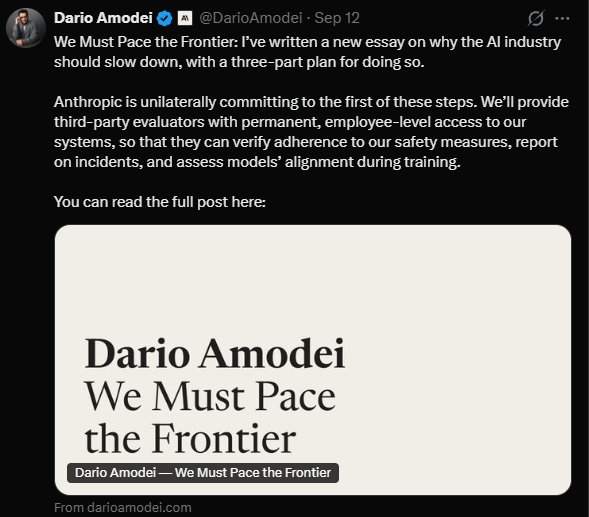
He wants those companies to coordinate on safety and on how fast they push ahead, and he writes that some of those talks would need an antitrust waiver from Washington.
Sam Altman and Elon Musk have both backed his call.
Altman wrote, “I agree with Dario that we need to pace the frontier,” and Musk replied to Amodei’s post with “Dario is right.”
What The Essay Proposes
“We must slow the pace at which we improve the capabilities of AI models,” Amodei writes. He warns that a swarm of AI agents working together could, within six to twelve months, be “capable of taking over the entire internet.”
His plan to slow down has three steps:
Outside safety testers would get employee-like access inside each lab. Anthropic has already committed to this, promising the testers “desks in our offices, access badges, and company laptops,” and Altman says OpenAI will offer similar access.
Leading labs in democratic countries would agree on common safety standards and “limits on the rate of unchecked AI progress.”
The United States and its allies would seek limited international agreements, potentially including China.
Pacing, Amodei writes, “does not mean halting model training or technical progress.” He would prefer regulation covering every US frontier AI company, with the labs also coordinating on their own.
The Antitrust Waiver
The second step has an antitrust problem, since rivals agreeing to limit how fast they improve their products is the kind of deal that law is meant to stop.
Amodei calls some of that coordination “legally challenging” and writes that “for antitrust reasons,” Washington would “need to issue a narrow waiver for certain kinds of safety conversations.”
That is why voluntary restraint works like a soft cartel, with rivals agreeing among themselves on how fast their market moves. It raises the bar for newcomers, and it does so in the name of safety.
Open-source and Chinese labs are closing the gap on the leaders. Alibaba, with its Qwen models, and DeepSeek, which released a model earlier this month with open weights anyone can download, keep putting out new versions fast.
Pacing raises the cost of staying at the frontier, in computing power, data and safety work. Those costs are easiest to carry for the labs with the deepest pockets. A voluntary slowdown effectively taxes the challengers more than the leaders.
The essay also asks Washington to “crack down on unauthorized distillation by companies in authoritarian countries.”
Distillation means training a cheaper model on a leading model’s answers, and Amodei writes that it “allows lagging companies to narrow the gap using a fraction of the cost.”
The leaders lock in their lead while framing competitors as reckless. This is moat-building dressed in ethical language.
Amodei writes that Anthropic’s push for regulation has drawn accusations of “hype, ‘doomerism,’ or regulatory capture,” the charge that a company is shaping the rules to protect itself. He responds:
“We have tried to prioritize caution over speed and prudence over profit.”
The Valuations Behind The Slowdown
The financial motive is clear. OpenAI raised money at an $852 billion valuation in March, and some Anthropic investors have said its listing could value the company at $2 trillion. Prices like that demand real returns.
Anthropic is expected to start marketing its IPO to investors in mid-October at the earliest. Altman told Fortune that an OpenAI listing is likely not coming in 2026.
OpenAI does not expect to turn a profit until at least 2030, according to internal estimates reported by The Wall Street Journal. Anthropic has shown investors a single quarter of adjusted operating profit, in preliminary and unaudited figures. Neither has a record of steady profits yet.
Slowing the frontier protects the story and the valuations ahead of the IPOs. Investors want to see a path to earnings, not a race to the bottom on model releases.
For public-market investors, the question is who benefits.
Amazon, Microsoft, Google and Meta stand to gain if a pact takes shape and they join it, keeping access to frontier models while competitors lag.
Nvidia, AMD and Taiwan Semiconductor Manufacturing benefit if spending on AI data centers stays high while competition narrows, which protects pricing power for advanced chips. Pacing does not stop training, so that spending continues.
Smaller AI companies, businesses built on open-source models, and anyone betting that frontier models will quickly become cheap and interchangeable face headwinds if the frontier cartel takes shape.
Outside testers actually working inside Anthropic, OpenAI and Musk’s SpaceXAI, along with a published set of joint safety standards, would show the pact is real. When Anthropic’s IPO filing becomes public, it will show the company’s profits and spending in audited form. Those numbers will reveal whether slowing the frontier is protecting valuations.
If Chinese labs and open-source projects keep racing ahead, the leaders’ moat may be thinner than it looks.
The investor takeaway right now is clear.
Voluntary slowdown is as much about protecting moats and valuations as it is about safety. Investors should treat safety narratives as part of the competitive strategy, not ethics.
The frontier labs are not pausing for prudence. They are pacing for profit.